

Advanced Warm-Up and Recovery Guide
Knee pain during Taraweeh can be prevented and relieved with the right warm-up, correct prayer posture, and smart recovery strategies. Most people experience knee discomfort due to prolonged standing, repeated sujood, weak thigh muscles, stiffness, or early arthritis — not because Taraweeh itself is harmful. With targeted physiotherapy-based preparation, you can pray comfortably throughout Ramadan without pain or stiffness. At Physio Resource, we treat knee pain daily using evidence-based physiotherapy, and prevention always starts before pain becomes chronic.
If you’re searching for knee pain prevention in Gulberg Lahore, this guide is written exactly for you.
Why Knee Pain Increases During Taraweeh
The physiotherapist views Taraweeh as a practice that creates multiple knee joint stresses through its sequences of:
- Sujood execution which requires users to perform deep knee flexion
- Qiyam execution which requires users to stand for extended periods
- The process of dropping into a seated position from a standing position.
The clinic observes three main conditions which include:
- Early stages of osteoarthritis
- Weakness in both quadriceps and gluteal muscles
- Hamstring and calf muscles which show tightness
- Ankle joints that restrict movement and create additional stress on the knees.
About 90 percent of knee pain cases show that people experience more than age-related changes because they show issues with their body mechanics.
Best Warm-Up Before Taraweeh (5–7 Minutes)
The best warm-up exercise for Taraweeh dedication requires a time period of 5 to 7 minutes. The short warm-up period establishes better blood circulation while joint movement improves and knee pressure decreases.
The following activities should occur before the prayer service starts.
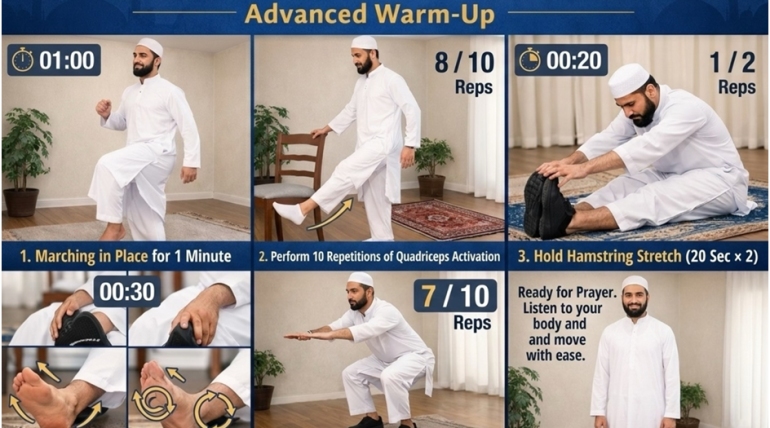
- Marching in place for 1 minute
- Performing 10 repetitions of quadriceps activation which requires knee straightening
- Holding a hamstring stretch for 20 seconds and repeating it twice
- Performing ankle pumps and circles for 30 seconds
- Performing 10 mini squats within a range that does not cause pain.
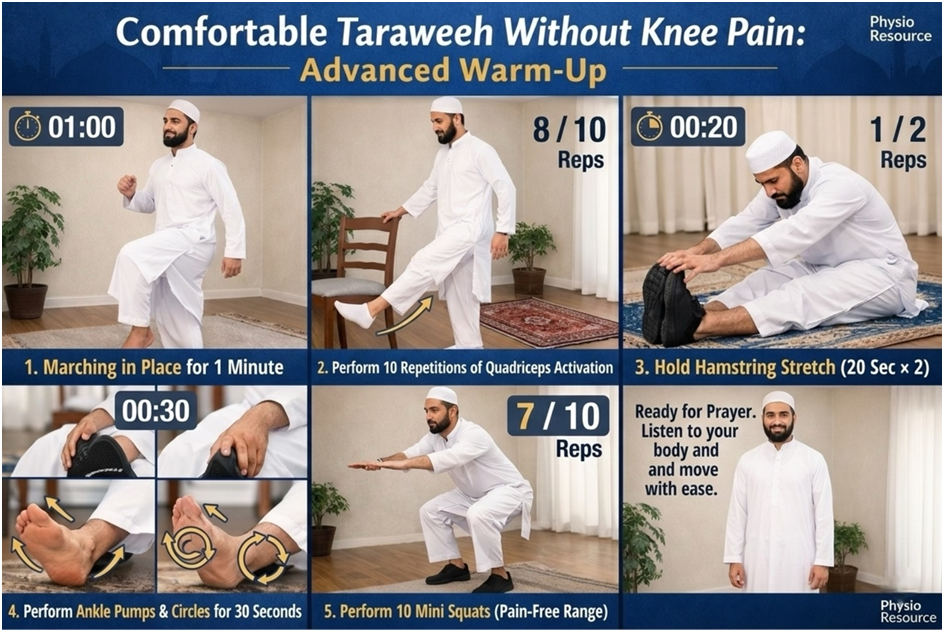
The system reduces stiffness while increasing comfort during sujood performance.
Proper Prayer Modifications for Knee Protection
You don’t need to push through pain. The Islamic faith allows people to choose between challenging and easier paths.
The physiotherapy team suggests patients to make these prayer modifications:
- A slightly raised prayer mat should be used for
- The user should sit on a small stool between rakats when necessary
- Users should not drop into sujood from standing positions.
- The user should keep their body straight during qiyam.
People who experience persistent pain should seek medical treatment because it indicates a health issue that should not be ignored.
Post-Taraweeh Recovery (What Most People Ignore)
The healing process takes place during the recovery period.
After the prayer ends, the user should:
- Warm compresses should be used to treat stiffness
- The user should perform 10 reps of gentle knee bends
- The user should perform light stretching of their quadriceps and calf muscles
- The user should refrain from sitting cross-legged for extended periods.
People should get medical evaluation when their pain lasts more than seven days and they experience swelling or find it difficult to use stairs.
Physiotherapy Treatment for Knee Pain in Lahore
At PhysioResource, we provide our clients with:
- Complete evaluation of knee function
- Treatment methods for pain relief which include manual therapy and taping
- Rehabilitation programs for strength development and mobility improvement
- A female physiotherapist who works in Gulberg Lahore to provide treatment for women who need private sessions
- We deliver home physiotherapy services throughout Lahore to treat elderly patients and those with busy schedules
We aim to achieve permanent knee health instead of providing temporary pain relief.
FAQs – Knee Pain and Taraweeh
Is knee pain during Taraweeh normal?
People who experience mild discomfort need to get their condition checked when they feel ongoing pain.
Can physiotherapy really prevent knee pain?
The answer is yes because clinical studies have demonstrated that strengthening exercises and mobility training and load management techniques lead to reduced knee pain.
When should I see a physiotherapist?
You need to visit a physiotherapist when your pain continues for more than one week or it becomes more severe or it restricts your ability to pray.
Author Introduction:
The complete work of Dr Ahmad Bilal DPT
Senior Musculoskeletal Physiotherapist
His clinical work focuses on treating knee pain and arthritis and sports injuries and postural rehabilitation. Dr Ahmad Bilal has extensive experience treating knee pain through evidence-based physiotherapy and functional rehabilitation.
🕒 Last Medically Reviewed: March 2026
Book Your Consultation Now – Enjoy Peaceful Prayer During Ramadan
You should not dismiss your knee pain if it prevents you from enjoying peaceful Taraweeh.
👉Schedule your appointment today at Physio Resource – Best Physiotherapy Clinic in Gulberg Lahore
✔ Our clinic has established trust with patients
✔ We provide superior medical treatment
✔ Our clinic provides both female and home physiotherapy services
People who want to pray comfortably need to maintain healthy knees.
Contact us
Physio Resource
Phone No: 0304-4283442
Address: 93-A1, Gurumangat Road, Gullberg, III Lahore
