

Have you ever felt a heaviness in your vagina, as if something is coming down or pushing against it? Perhaps you notice a small bulge when standing, walking, lifting your baby or going to the bathroom.
These symptoms can be worrying, but they are not something you need to feel embarrassed about. They may be signs of pelvic organ prolapse (POP), a condition in which the bladder, uterus or rectum loses some of its normal support and presses into the vaginal wall.
The good news is that pelvic floor physiotherapy can help many women manage pelvic organ prolapse symptoms, particularly in mild to moderate cases.
What Does Pelvic Organ Prolapse Feel Like?
Women with pelvic organ prolapse may experience:
- A feeling of vaginal bulging or a lump inside or near the vaginal opening.
- Heaviness, dragging or pressure in the pelvic area.
- Symptoms that become more noticeable after standing for a long time.
- Urine leakage when coughing, sneezing or exercising.
- Difficulty emptying the bladder or bowel.
- Lower back or pelvic discomfort.
Prolapse can develop after pregnancy and childbirth, but it can also occur with ageing, menopause, chronic constipation, persistent coughing or repeated heavy lifting.
If you are experiencing vaginal pressure or a bulging sensation, a medical assessment is important. These symptoms should not automatically be assumed to be prolapse.
Also read: Can Physiotherapy Help With Pelvic Floor Problems? Causes, Treatment & Recovery
Can Physiotherapy Improve Pelvic Organ Prolapse?
Yes. A properly planned pelvic floor physiotherapy programme can improve muscle function, support and symptom control.
Clinical guidance recommends supervised pelvic floor muscle training as a first treatment option for many women with symptomatic stage 1 or stage 2 prolapse. NICE recommends a supervised programme lasting at least 16 weeks, with longer programmes considered in some circumstances. Physiotherapy may improve symptoms, but it does not guarantee that the prolapsed organ will return completely to its original position.
A pelvic health physiotherapist may work on:
- Pelvic floor muscle strength and coordination.
- Correct breathing during everyday activities.
- Abdominal and hip muscle control.
- Reducing unnecessary pressure on the pelvic floor.
- Safe ways to lift, exercise and return to daily activities.
4 Practical Ways to Support Your Pelvic Floor
These gentle strategies may help you manage pressure on your pelvic floor. They are not a substitute for an individual assessment.
1. Practise gentle pelvic floor contractions
Sit or lie comfortably. Gently tighten the muscles around the vagina and anus as if trying to prevent passing wind. Imagine the muscles lifting inward and upward. Hold briefly, then fully relax. Keep breathing normally.
Do not repeatedly squeeze if the exercise causes pain, heaviness or discomfort. Some women need pelvic floor relaxation and coordination rather than strengthening alone.
2. Avoid holding your breath when lifting
Before lifting your child, a shopping bag or another object, breathe out gently as you make the effort. Avoid straining or holding your breath.
3. Prevent constipation
Drink enough water, eat fibre-rich foods and avoid prolonged straining on the toilet. Constipation can increase pressure on the pelvic floor.
4. Adjust activities that increase symptoms
If running, jumping or heavy lifting makes the vaginal pressure worse, reduce or modify that activity and seek professional advice. Gentle walking may remain comfortable for many women.
What Happens During a Pelvic Floor Physiotherapy Assessment?
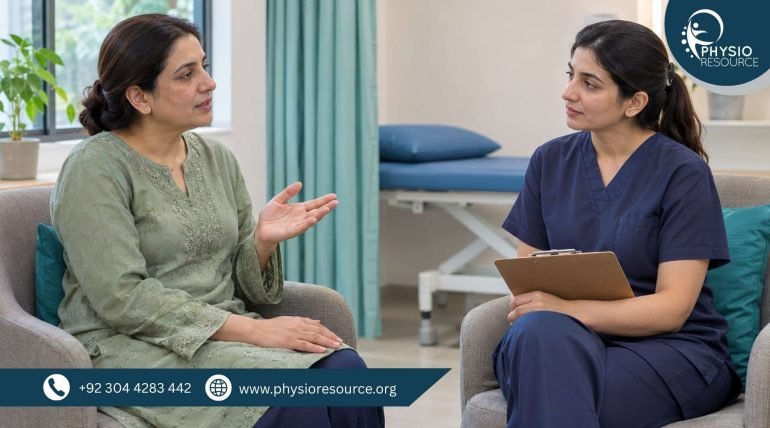
A pelvic health assessment usually includes a discussion of your symptoms, childbirth history, bladder and bowel habits, daily activities and treatment goals. The physiotherapist may assess breathing, abdominal control and pelvic floor muscle function.
An internal vaginal examination is not automatically required. If it is clinically appropriate, it should only be performed with your informed consent.
For some women, treatment may also involve a gynaecologist or urogynecologist. A vaginal pessary, which is a supportive device placed inside the vagina, may be another non-surgical
option. More advanced or troublesome prolapse may require specialist medical or surgical advice.
Looking for Pelvic Floor Physiotherapy in Lahore?
If you are searching for pelvic floor physiotherapy in Lahore, women’s health physiotherapy near me or a physiotherapy clinic in Gulberg III, getting the right assessment is an important first step.
At Physio Resource, located at 93-A1, Gurumangat Road, Gulberg III, Lahore, you can contact the clinic to enquire about women’s health and pelvic floor assessment availability.
Do not ignore persistent vaginal pressure, bulging or difficulty emptying your bladder. Understanding the cause can help you choose the right treatment.
Book an enquiry with Physio Resource:
Contact us
Phone No: 0304-4283442
Physio Resource
Address: 93-A1, Gurumangat Road, Gullberg, III Lahore
Frequently Asked Questions
1. Can pelvic organ prolapse be cured with physiotherapy?
Physiotherapy can improve pelvic floor function and reduce symptoms, but it cannot guarantee complete correction of the prolapse.
2. Is walking safe if I have pelvic organ prolapse?
Walking is comfortable for many women. Adjust your activity if it increases pressure, bulging or discomfort.
3. Can prolapse happen after childbirth?
Yes. Pregnancy and childbirth can affect the muscles and connective tissues that support the pelvic organs.
4. Should I do Kegel exercises if I feel vaginal pressure?
Not without understanding your pelvic floor function. Some women benefit from strengthening, while others need relaxation and coordination.
5. Do I need surgery for pelvic organ prolapse?
Not necessarily. Treatment depends on the type, severity and impact of symptoms. Physiotherapy and pessaries are non-surgical options; surgery may be considered when symptoms are more severe or other treatments have not helped.
Author
Dr. Ahmed Bilal — Physio Resource
Dr. Ahmed Bilal is the named author of this educational article for Physio Resource. The article provides general health information and does not replace an individual clinical assessment.

