

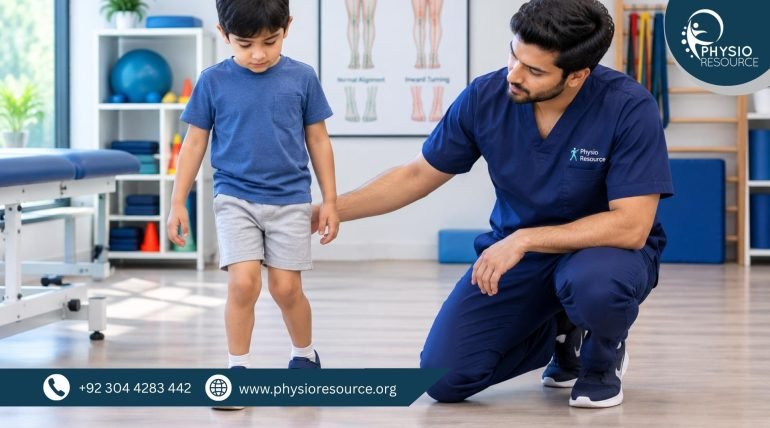
Does Intoeing Need Treatment?
If your child’s feet turn inward while walking or running, you may be wondering whether something is wrong or whether treatment is necessary. Intoeing, sometimes called pigeon-toed walking, is common in young children and often improves naturally as they grow. However, an assessment may be helpful if the intoeing is severe, affects only one leg, causes frequent tripping, pain, or interferes with walking, running, or playing.
Why Do Children Walk With Their Feet Turned In?
Intoeing can come from different parts of the leg:
- Metatarsus adductus: The front of the foot curves inward. Mild and flexible cases often improve as the child grows.
- Internal tibial torsion: The shinbone turns inward, making the feet point toward each other.
- Femoral anteversion: The thighbone has an inward rotation, which can make both the knees and feet appear turned inward.
These are common developmental variations, and most children improve without aggressive treatment.
Does Intoeing Need Physiotherapy?
Not every child with intoeing needs physiotherapy. If your child has no pain, walks and runs normally, and is developing appropriately, monitoring may be all that is required.
However, pediatric physiotherapy can be useful when intoeing is associated with balance difficulties, muscle weakness, coordination problems, frequent falls, or functional limitations. A pediatric physiotherapist can assess your child’s walking pattern, posture, balance, strength, flexibility, and overall motor development to determine whether intervention is appropriate.
Parents looking for the best child physiotherapist, best pediatric physiotherapist, or best child specialist physiotherapist should look for someone experienced in assessing children’s movement and developmental needs—not simply someone who promises to “straighten” the feet.
Should My Child Wear Special Shoes or Braces?
In most developmental cases of intoeing, special shoes, braces, or splints do not speed up the natural correction. Well-fitting, comfortable footwear is generally recommended. Children should also be encouraged to remain active rather than avoiding sports or normal play.
Some children may benefit from exercises or activity-based physiotherapy when there are associated strength, balance, or functional problems. The treatment should be based on the individual child’s assessment rather than applying the same exercises to every child.
Get solution: Paediatric Flat Feet Treatment in Lahore – Book an Appointment Now
When Should Parents Seek an Assessment?
Consider getting your child assessed if:
- Intoeing is noticeably worse on one side.
- Your child frequently trips or falls.
- Walking or running is becoming difficult.
- There is pain in the foot, ankle, knee, hip, or leg.
- The foot appears stiff or unusually shaped.
- Intoeing is severe or not improving as your child grows.
- Your child is avoiding physical activities because of the problem.
Early assessment can also help parents understand whether the walking pattern is simply part of normal development or whether another movement or developmental issue should be considered.
Help Your Child Move With Confidence
At Physio Resource in Gulberg, Lahore, pediatric physiotherapy focuses on understanding each child’s movement, strength, balance, coordination, and functional needs. If you are
concerned about your child’s walking pattern, a professional assessment can give you clearer answers instead of relying on guesswork.
Concerned about your child’s feet turning inward? Contact Physio Resource to discuss a pediatric physiotherapy assessment.
Contact us
Physio Resource
Phone No: 0304-4283442
Address: 93-A1, Gurumangat Road, Gullberg, III Lahore
Frequently Asked Questions
1. Is intoeing normal in toddlers?
Yes. Intoeing is common during early childhood and frequently improves naturally with growth.
2. Will my child grow out of intoeing?
Most children improve as the bones and walking pattern mature. The timeframe varies depending on the underlying cause.
3. Can physiotherapy correct intoeing?
Physiotherapy does not need to “correct” normal bone development. However, it can help when a child has associated weakness, balance, coordination, or functional difficulties.
4. Should I stop my child from playing sports?
Usually, no. Children with uncomplicated intoeing can generally participate in normal physical activities.
5. When should I see a child physiotherapist?
If your child has frequent falls, difficulty running, pain, noticeable weakness, developmental concerns, or difficulty participating in activities, a pediatric physiotherapy assessment can help identify what support may be appropriate.

