

Which Treatment Should I Discuss With My Therapist in Lahore?
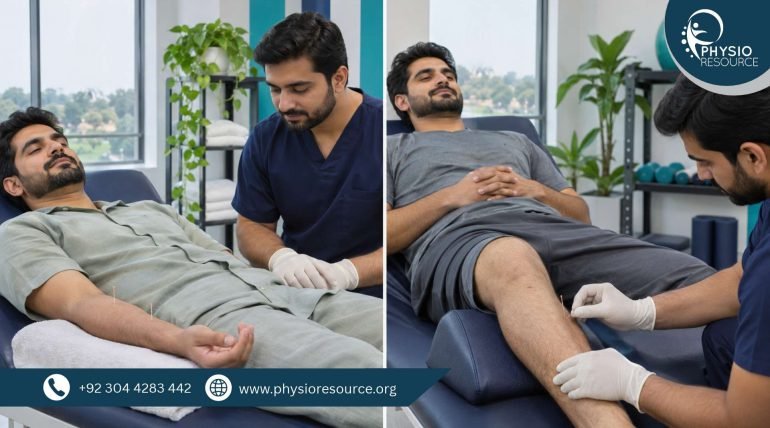
If you have persistent muscle pain, tightness or trigger points, you may be considering acupuncture or dry needling. Both treatments use fine needles, but they differ in their treatment approaches and clinical reasoning. Dry needling usually targets selected muscles and trigger points associated with movement-related pain, while traditional acupuncture uses points selected within an acupuncture system, often based on Traditional Chinese Medicine.
Neither treatment is automatically better. Your symptoms, diagnosis, medical history and treatment goals should guide the decision.
What Is the Difference Between Acupuncture and Dry Needling?
Although both involve inserting thin needles through the skin, their approaches are different.
What Is Dry Needling?
Dry needling is a technique used by appropriately trained healthcare practitioners, including some physiotherapists. It involves inserting a thin, solid needle into selected muscles or other soft tissues.
The therapist may choose a target based on:
- Muscle tenderness or sensitivity.
- Suspected myofascial trigger points.
- Restricted movement.
- Pain reproduced during examination.
- Muscle-related movement difficulties.
The aim may be to reduce pain sensitivity, improve movement or help a patient participate more comfortably in rehabilitation.
You may also like: Can Acupuncture Help Neck and Shoulder Pain? All you Need to Know
What Is Acupuncture?
Traditional acupuncture is a practice originating in Chinese medicine. Practitioners insert fine needles at selected acupuncture points, often using a meridian-based treatment framework.
Depending on the practitioner’s approach, acupuncture may be used for different types of pain and other symptoms.
Some modern acupuncture approaches also use anatomical and musculoskeletal reasoning. Therefore, the exact method should be discussed rather than assuming every acupuncture treatment follows the same approach.
Which Treatment May Be More Suitable for Muscle Pain?
The most appropriate option depends on the problem being treated.
| Your concern | What to discuss |
| Localised muscle tenderness or trigger points | Whether dry needling is appropriate |
| Persistent back or neck pain | A full assessment and whether acupuncture or needling could be an additional option |
| General pain-management goals | Whether acupuncture may fit your treatment plan |
| Restricted movement and muscle weakness | Rehabilitation exercises alongside any needling treatment |
| Pain that keeps returning | The underlying cause, activity levels and longer-term management |
For example, if your shoulder pain is associated with muscle tenderness and reduced movement, a therapist may assess whether dry needling is appropriate. However, if the problem is primarily related to a joint, tendon, nerve or another condition, needling the surrounding muscle may not address the main cause.
Do Acupuncture and Dry Needling Actually Work?
Both approaches may help some people with musculoskeletal pain, but results vary depending on the condition and individual.
The World Health Organization’s guideline for chronic primary low back pain allows needling therapies, including acupuncture and other dry needling approaches, as possible components of care. However, the recommendation is conditional and based on low-certainty evidence.
This means:
- Some people may experience short-term pain relief.
- Improvements in movement and daily function may vary.
- Results are not guaranteed.
- Needling should generally complement, rather than replace, appropriate exercise, education and rehabilitation.
A useful treatment plan should measure progress through practical changes, such as improved walking, reaching, lifting or sleeping—not simply whether the muscle feels different immediately after treatment.
What Are the Possible Risks and Side Effects?
Needling treatments are generally associated with minor side effects, but they are not risk-free.
Possible effects include:
- Temporary soreness around the needle site.
- Minor bleeding or bruising.
- Temporary dizziness or feeling faint.
- Short-term aggravation of symptoms.
Rare but serious complications can occur. For example, needling around the chest, upper back or shoulder region can carry a risk of pneumothorax (collapsed lung) if the needle enters the chest cavity.
Discuss your medical history before treatment, particularly if you:
- Take blood-thinning medication.
- Have a bleeding or clotting disorder.
- Have an active skin infection or open wound near the treatment area.
- Have a weakened immune system.
- Are pregnant or may be pregnant.
- Have a significant needle phobia or difficulty remaining still.
Your practitioner should explain the procedure, obtain informed consent, use sterile single-use needles and follow appropriate infection-control precautions.
What Should You Ask Your Therapist Before Choosing?
Before agreeing to either treatment, ask:
- What is the likely cause of my muscle pain?
- Why are you recommending acupuncture or dry needling?
- Which tissues or points will be targeted?
- What benefits should I realistically expect?
- What are the risks given my medical history?
- How will we measure whether the treatment is helping?
- What exercises or rehabilitation will accompany the treatment?
- What will we do if my symptoms do not improve?
Also ask about the practitioner’s training and experience with the specific needling technique. A qualified practitioner should be able to explain why the treatment is appropriate for your condition.
Should Needling Be the Only Treatment for Muscle Pain?
Usually, it should not be the entire plan.
Muscle pain may be influenced by training load, posture, repetitive activities, joint mobility, muscle strength, sleep and other health factors.
Depending on your assessment, a broader rehabilitation programme may include:
- Progressive strengthening exercises.
- Mobility and flexibility work.
- Movement retraining.
- Activity and workload adjustments.
- Advice on managing symptoms.
- Gradual return to sport or everyday activities.
If needling provides temporary relief, exercise and movement-based rehabilitation may help you use that improvement to work towards better function.
Acupuncture and Dry Needling in Lahore: Where Should You Start?
If you are experiencing recurring muscle pain, stiffness or movement restrictions, start with a proper assessment rather than choosing a treatment based only on the name or popularity of a technique.
At PhysioResource in Gulberg III, Lahore, contact the clinic to enquire about available physiotherapy assessment and rehabilitation options. Ask whether dry needling is offered, which qualified practitioner performs it and whether it is appropriate for your particular condition. Do not assume acupuncture is available unless the clinic confirms it.
The objective should be to identify the cause of your pain and select a treatment plan that supports lasting improvements in movement and daily activities.
Contact us
Physio Resource
Phone No: 0304-4283442
Address: 93-A1, Gurumangat Road, Gullberg, III Lahore
Frequently Asked Questions
Is dry needling more painful than acupuncture?
Experiences vary. You may feel a brief prick, pressure, muscle twitch or temporary soreness with either technique. Tell your practitioner if you feel uncomfortable, anxious or unwell during treatment.
Can acupuncture and dry needling be used together?
They may both be considered in a broader care plan, but using both is not automatically necessary. Your practitioner should explain the purpose of each technique and avoid unnecessary treatment.
How many dry needling or acupuncture sessions will I need?
There is no fixed number. It depends on your diagnosis, symptom duration, response to treatment and overall rehabilitation goals. Your progress should be reviewed rather than continuing sessions without a clear reason.
Can dry needling permanently remove muscle knots?
There is no guarantee that needling will permanently remove a trigger point or prevent pain from returning. If the underlying problem involves repeated muscle overload, weakness or movement difficulties, those factors also need attention.
Is dry needling safe for everyone?
No. Certain medical conditions, medications, infections, bleeding risks and pregnancy-related considerations may require treatment modification or avoidance. A practitioner should screen you before starting.
Should I choose acupuncture or dry needling for back pain in Lahore?
Neither should be selected without understanding the cause of your back pain. A qualified clinician can assess whether the symptoms are muscle-related and whether needling is a suitable addition to exercise-based care.
Author: Dr Ahmad Bilal, DPT — Doctor of Physical Therapy.
Clinical review note: Have this article reviewed by a qualified musculoskeletal clinician before publication. Confirm the author’s credentials and the clinic’s actual needling services and practitioner qualifications before making service claims.
If you have persistent muscle pain, tightness or trigger points, you may be considering acupuncture or dry needling. Both treatments use fine needles, but they differ in their treatment approaches and clinical reasoning. Dry needling usually targets selected muscles and trigger points associated with movement-related pain, while traditional acupuncture uses points selected within an acupuncture system, often based on Traditional Chinese Medicine.
Neither treatment is automatically better. Your symptoms, diagnosis, medical history and treatment goals should guide the decision.

