

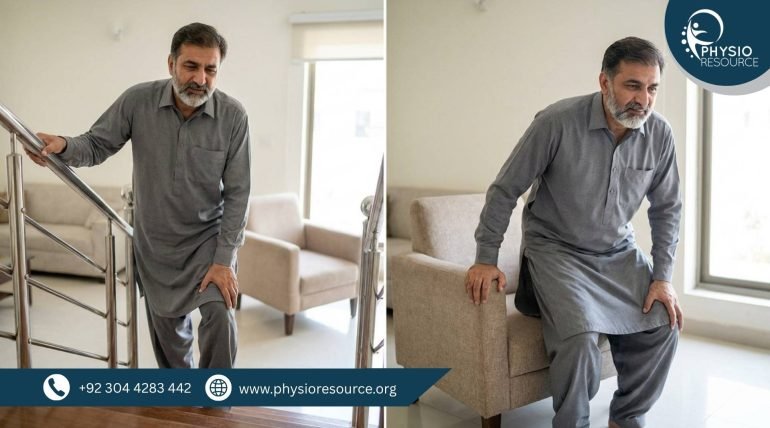
Knee pain during stair climbing or standing up from a chair often happens because the kneecap and knee joint are under pressure when you bend and bear weight. Typical reasons for knee pain are pain, weak muscles, irritated tendons, arthritis, bad movement habits or earlier knee injuries. If knee pain keeps returning or starts to disturb life seeing a physiotherapist can help find the true cause.
Why Do Stairs Make Knee Pain Worse?
Climbing stairs requires the knee and thigh muscles to work than they do during normal walking. The quadriceps and hip muscles have to generate force to lift and control the body. If the muscles are weak the knee is stiff or the kneecap is not moving efficiently knee pain may appear around the front or sides of the knee. Going downstairs can also cause discomfort because the muscles must control the body as it moves downward.
Why Does My Knee Hurt When Getting Up From a Chair?
Standing up from a chair involves bending and then straightening the knee while the body weight is supported by the legs. The deeper the chair the more the knee may need to bend. This can increase pressure around the kneecap. Demand more work from the quadriceps. Knee pain may feel like:
- Pain at the front of the knee
- Stiffness after sitting
- Difficulty standing from a chair
- Pain during squatting
- Discomfort after sitting for a long time
- Clicking or grinding sensations
These symptoms do not necessarily mean arthritis. The cause of knee pain needs to be assessed based on movement, strength and medical history.
You may also like: Do I Need Physiotherapy After Knee Replacement?
Common Causes of Knee Pain on Stairs
- Patellofemoral Pain – Pain around or behind the kneecap can become worse with stairs, squatting, running or getting up after sitting. It is sometimes called “runner’s knee ” although it can affect people who do not run.
- Thigh or Hip Muscles– The knee depends on the muscles of the thighs, hips and lower legs for stability and movement control. Weakness can make everyday activities such as stairs and sit-to-stand movements more demanding.
- Knee Osteoarthritis – Osteoarthritis can cause knee pain, stiffness, swelling and reduced mobility. Symptoms may become more noticeable during weight-bearing activities, stairs and standing from a chair.
- Tendon Problems – The quadriceps tendons help transfer force from the thigh muscles to the knee. Irritation or overload of these structures may cause knee pain during stairs jumping, squatting or standing.
- Previous Knee Injury – A previous meniscus, ligament, cartilage or other knee injury can affect strength and movement patterns even after the initial injury appears to have healed.
Can Physiotherapy Help Knee Pain?
Yes. Physiotherapy can help people with knee pain by addressing the factors that contribute to knee pain. A physiotherapist may assess:
- Hip strength
- Joint mobility
- Flexibility
- Squatting technique
- Sit-to-stand movement
- Walking and stair mechanics
- Pain patterns
- Previous injuries
- Daily activity limitations
Treatment depends on the findings. It may include strengthening exercises, mobility exercises, manual therapy, movement retraining, activity modification and a personalized home exercise programme.
The goal is not simply to make knee pain disappear temporarily. It is to improve how the knee handles movement and gradually restore confidence and function.
What Can You Do at Home?
If knee pain is mild and there has been no injury some simple changes may help
- Avoid suddenly increasing stair or exercise intensity.
- Don’t remain seated for periods without moving.
- Use a chair if getting up from a low chair is painful.
- Gradually strengthen thigh and hip muscles.
- Avoid performing movements that cause sharp knee pain.
- Maintain comfortable movement rather than complete rest.
- Follow advice if knee pain continues.
Remember that an exercise that helps one type of knee problem may aggravate another. This is why an individualized assessment is valuable when knee pain persists.
When Should You See a Physiotherapist?
You should consider getting knee pain assessed if:
- Knee pain lasts for weeks.
- Knee pain keeps coming
- Knee pain is gradually getting worse.
- Stairs become difficult because of knee pain.
- Walking, exercise or daily activities are limited by knee pain.
- Knee pain is associated with swelling or stiffness.
- Knee pain started after a knee injury.
If you cannot put weight on the leg the knee becomes severely swollen or deformed. It locks and cannot move normally after an injury seek prompt medical evaluation.
Contact us
Physio Resource
Phone No: 0304-4283442
Address: 93-A1, Gurumangat Road, Gullberg, III Lahore
Frequently Asked Questions
Is knee pain on stairs always arthritis?
No. Knee pain on stairs can result from conditions, including patellofemoral pain, muscle weakness, tendon irritation, previous injuries and arthritis.
Why does my knee hurt when I stand after sitting?
The knee has to move from a position while thigh and hip muscles generate force. Weakness, stiffness or irritation around the knee can make this movement painful.
Should I stop using stairs if my knee hurts?
Not. Avoiding all movement is usually not the long-term solution. A physiotherapist can help determine which activities are appropriate and how to gradually build tolerance.
Can strengthening exercises reduce knee pain?
For common knee problems appropriately selected strengthening exercises can improve muscle capacity and movement control and help reduce knee pain.
How long does knee pain take to improve?
It depends on the underlying cause, severity, activity level and consistency with rehabilitation. Some problems improve within weeks while chronic or more complex conditions may require longer-term management.
Schedule an Appointment
If climbing stairs or getting up from a chair has become painful don’t simply assume it is ” wear and tear.” Understanding the cause of knee pain is the step toward appropriate treatment.
At Physio Resource in Gulberg, Lahore physiotherapy can help assess movement, strength, mobility and functional limitations and develop a rehabilitation plan suited to your needs.
Book an assessment today. Take the first step, toward moving with greater comfort and confidence.

