

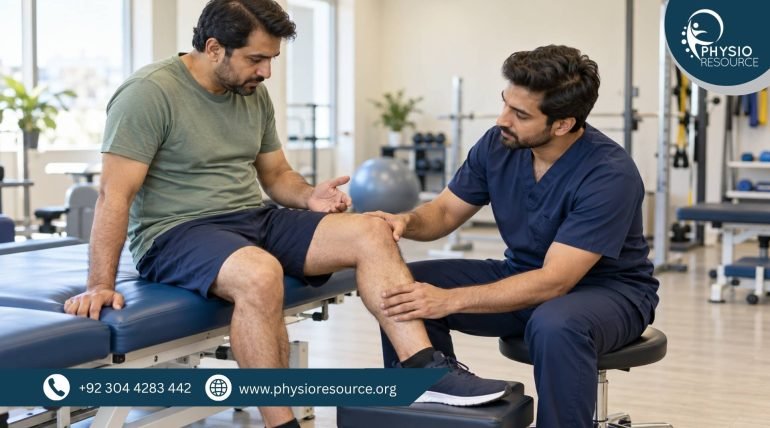
If your knee catches, locks or feels stuck when you bend it, the cause may be irritation, swelling or a problem inside the knee joint. One possible cause is a meniscus tear—the meniscus is the cartilage that cushions the knee—but other conditions can cause similar symptoms. A knee that becomes physically stuck and cannot fully straighten needs urgent medical assessment.
What Is the Difference Between Knee Clicking, Catching and Locking?
These symptoms can feel similar, but the difference matters:
- Clicking: You hear or feel a sound as the knee moves, but movement remains normal. Painless clicking alone is often harmless.
- Catching: Your knee briefly hesitates, snags or feels as if something is interfering with smooth movement.
- Locking: Your knee becomes stuck, particularly if you cannot fully straighten it. This may indicate a mechanical problem inside the joint.
Do not force your knee straight if it feels physically blocked.
You may also like: Why Does My Knee Hurt When Climbing Stairs. Getting Up From a Chair? – Must Read
What Causes a Knee to Lock or Catch?
1. Meniscus tear
The menisci are two crescent-shaped pieces of cartilage that help absorb shock and distribute weight in the knee. A tear can occur during a twisting movement, a sports injury, a deep squat or, sometimes, an ordinary movement in an ageing knee.
Symptoms may include pain along the joint line, swelling, stiffness, catching, giving way or difficulty fully straightening the leg.
2. Knee cartilage or joint-surface problems
Damage or loose fragments inside the joint can interfere with smooth movement. Osteoarthritis may also cause stiffness, grinding or painful movement, particularly in older adults.
3. Kneecap tracking problems
If the kneecap does not move smoothly as the knee bends and straightens, you may experience discomfort, clicking or a catching sensation. This is not the same as a physically locked knee, so assessment is important if symptoms persist.
4. Swelling after an injury
Fluid and inflammation inside the knee can restrict movement and make bending or straightening difficult. A ligament injury or another internal knee problem may occur alongside swelling, particularly after a sudden twist or impact.
These symptoms alone cannot confirm which structure is affected.
When Should You Get Your Knee Checked?
Seek urgent medical care if:
- Your knee is stuck and you cannot fully bend or straighten it.
- You cannot bear weight or walk after an injury.
- The knee becomes severely swollen or changes shape after trauma.
- Your knee is hot and red, especially with fever or feeling unwell.
Arrange a clinical assessment if catching or locking keeps returning, pain is worsening, swelling develops, your knee gives way, or symptoms interfere with walking, stairs, work or sleep.
What Can You Do Safely Until You Are Assessed?
If there are no urgent warning signs:
- Stop deep squats, kneeling, pivoting and movements that trigger catching.
- Apply a cold pack wrapped in a towel for up to 15–20 minutes at a time.
- Rest from aggravating activities and elevate the leg if it is swollen.
- Avoid forcing the knee through a blocked or painful movement.
- Arrange an assessment if symptoms persist or recur.
Do not start aggressive stretching or strengthening exercises while the knee is locking. Exercise selection depends on the cause and whether a significant injury is present.
How Is Knee Locking Diagnosed and Treated?
A clinician will ask how symptoms began, whether there was a twist or impact, where the pain occurs and whether the knee can fully straighten. The examination may assess swelling, movement, stability and tenderness. Depending on the findings, an X-ray or MRI may be appropriate; not everyone needs a scan.
Treatment depends on the diagnosis. Some knee problems improve with activity modification and guided physiotherapy to restore movement, strength and control. Other problems—
particularly a persistently locked knee or certain meniscus injuries—may require an orthopaedic assessment and sometimes surgery.
Physiotherapy should be tailored to the diagnosis rather than used to push through a mechanical block.
Knee Locking Assessment in Lahore
If your knee repeatedly catches when bending, climbing stairs, squatting or getting up from a chair, getting the cause checked can help guide the next step.
At PhysioResource in Gulberg III, Lahore, contact the clinic to ask about knee assessment and appropriate rehabilitation or referral options. If your knee is currently stuck, you cannot bear weight, or you have severe swelling, fever or redness, seek urgent medical care rather than waiting for a routine physiotherapy appointment.
Book an assessment if your symptoms are recurring, and explain when the locking happens, whether swelling is present and whether you can fully straighten the knee.
Contact us
Physio Resource
Phone No: 0304-4283442
Address: 93-A1, Gurumangat Road, Gullberg, III Lahore
Frequently Asked Questions
Is knee locking always a meniscus tear?
No. A meniscus tear is one possible cause, but cartilage problems, swelling and other knee conditions can produce similar symptoms. Examination is needed to determine the likely cause.
Is knee clicking without pain dangerous?
Painless clicking with normal movement is often not a cause for concern. However, clicking accompanied by pain, swelling, catching, instability or restricted movement should be assessed.
Can physiotherapy fix a knee that locks?
Physiotherapy may help many knee conditions, but treatment depends on the cause. A knee that is physically stuck or cannot fully straighten needs urgent medical assessment before exercises are attempted.
Should I keep walking if my knee catches?
Avoid activities that repeatedly trigger catching. If you cannot bear weight, have severe pain or the knee is stuck, seek urgent medical care. If you can walk but symptoms keep recurring, arrange an assessment.
Do I need an MRI for a locking knee?
Not always. A clinician decides whether imaging is needed based on your history and examination. An X-ray may help assess bones and arthritis, while an MRI can show soft-tissue structures such as the meniscus.
When should I see a physiotherapist in Lahore?
Arrange an assessment if catching, pain or stiffness keeps returning or limits daily activities. If the knee is physically locked, severely swollen after injury, hot and red with fever, or you cannot bear weight, seek urgent medical care first.
Author: Dr Ahmad Bilal, DPT — Doctor of Physical Therapy.

