

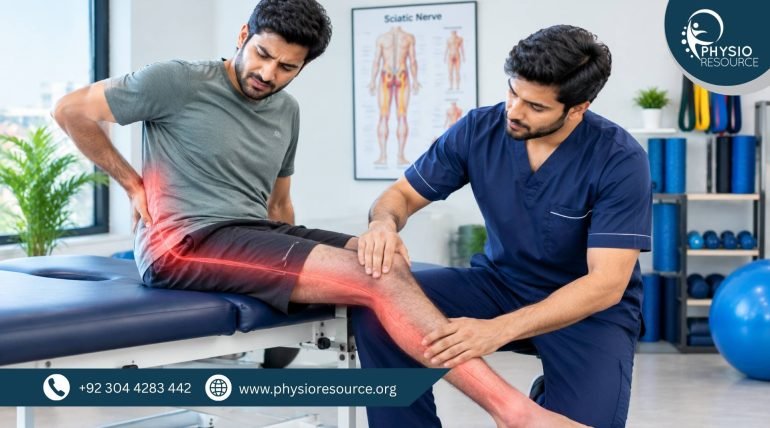
If your back pain travels down one leg, it may be sciatica, but not every case of radiating leg pain is caused by a nerve problem. Sciatica commonly involves pain that travels from the lower back or buttock down the leg and may be accompanied by tingling, numbness or weakness. A muscle strain, on the other hand, usually causes more localized muscle pain and tenderness. Because these conditions can feel similar, a proper assessment is important before deciding on treatment.
At Physio Resource in Gulberg, Lahore, physiotherapy assessment can help identify possible causes of back and leg pain and develop an individualized rehabilitation plan.
What Does Sciatica Feel Like?
Sciatica refers to symptoms caused by irritation or compression affecting the sciatic nerve or its nerve roots in the lower back.
Pain may travel:
Lower back → buttock → back or side of the leg → sometimes the foot
People may describe the pain as:
- Sharp or shooting
- Burning
- Electric or tingling
- Aching that travels down the leg
- Associated with numbness
- Sometimes accompanied by weakness
Sciatica often affects one side, although symptoms can vary.
Importantly, having pain in the leg does not automatically prove that you have sciatica. A clinical assessment is needed to understand the source of the symptoms.
You may also like: Say Goodbye to Sciatica Pain in 10 Minutes
Could It Be a Muscle Strain Instead?
A lower-back or buttock muscle strain can occur after lifting, exercising, twisting, sudden movement or overuse.
Muscle-related pain is often:
- More localized
- Tender when the affected muscle is touched
- Worse with certain movements or muscle contractions
- Associated with stiffness
- Less likely to cause tingling or numbness
For example, if you developed back pain after lifting something heavy and the pain remains mainly around the lower back muscles, a strain may be one possibility.
However, symptoms can overlap, which is why self-diagnosing based on one symptom can be misleading.
Sciatica vs Muscle Strain: What Is the Difference?
| Symptom | Possible Sciatica | Possible Muscle Strain |
| Pain travels down the leg | Common | Less typical |
| Tingling or pins and needles | May occur | Uncommon |
| Numbness | May occur | Uncommon |
| Muscle tenderness | May occur | Common |
| Pain with muscle use | Possible | Common |
| Weakness | May occur | Possible due to pain |
| Pain after lifting | Can happen | Common |
| Back or buttock pain | Common | Common |
These are general patterns, not a diagnosis. Several other conditions can also cause back and leg pain.
Why Does Back Pain Travel Down the Leg?
The nerves supplying the leg originate from the lower spine. When structures around these nerves become irritated or compressed, symptoms can sometimes be felt further away from the original source.
This is why someone may feel pain primarily in their buttock, thigh or calf even though the problem originates in the lower back.
A disc-related problem is one possible cause of nerve irritation, but it is not the only possibility.
Can Physiotherapy Help Sciatica?
For many people with uncomplicated low-back and leg pain, physiotherapy can be an important part of conservative management.
Your physiotherapist may assess:
- Spinal movement
- Hip movement
- Muscle strength
- Sensation
- Reflexes when appropriate
- Walking pattern
- Functional movements
- Symptoms during different positions
- The effect of coughing, sneezing or straining when relevant
- Your daily activities and work demands Treatment depends on the findings.
It may include:
- Therapeutic exercises
- Strengthening
- Mobility exercises
- Movement education
- Activity modification
- Manual therapy where appropriate
- Progressive return to normal activities
- A personalized home exercise programme
The goal is not simply to reduce pain temporarily. Rehabilitation should help you gradually restore movement, strength, confidence and function.
What Can You Do at Home?
If your symptoms are mild and there are no warning signs, staying appropriately active is often preferable to prolonged bed rest.
You can try:
- Taking short, comfortable walks.
- Avoiding prolonged sitting in one position.
- Changing positions regularly.
- Temporarily reducing activities that clearly worsen symptoms.
- Following exercises recommended for your specific condition.
- Returning gradually to normal activity as symptoms improve.
Avoid copying random “sciatica exercises” from the internet. An exercise that helps one person may aggravate another person’s symptoms.
When Should You See a Physiotherapist?
Consider getting assessed if:
- Back pain repeatedly travels into your leg.
- Pain is interfering with walking or daily activities.
- You have persistent tingling or numbness.
- Symptoms are not improving.
- Pain keeps returning.
- You are avoiding normal activities because of the pain.
- You have difficulty returning to exercise or work.
Early assessment can help identify whether the symptoms are more consistent with a nerve-related problem, muscle injury, joint problem or another condition.
When Is Back and Leg Pain an Emergency?
Most cases of back pain with leg symptoms are not emergencies, but certain symptoms require urgent medical assessment.
Seek urgent medical care if back pain is accompanied by:
- New loss of bladder or bowel control
- Numbness around the groin or inner thighs
- Significant or rapidly worsening leg weakness
- Severe symptoms affecting both legs
- Major trauma
- Fever or serious systemic illness with severe back pain
These symptoms can indicate a condition requiring prompt medical evaluation.
Can Physiotherapy Prevent Sciatica From Coming Back?
Physiotherapy cannot guarantee that sciatica will never return, but rehabilitation can help improve strength, movement capacity and confidence with physical activity.
A long-term programme may include:
- Core and trunk strengthening
- Hip strengthening
- Mobility exercises
- Gradual activity progression
- Lifting and movement education
- Workstation or ergonomic advice
- Regular physical activity
Consistency is generally more useful than relying on treatment only when pain becomes severe.
Why Choose Physio Resource?
At Physio Resource, treatment is based on individual assessment rather than assuming that every case of back pain is the same.
If you are searching for the best physiotherapist in Lahore, the important consideration is whether your condition is properly assessed and whether your rehabilitation programme is tailored to your symptoms, goals and daily activities.
Patients looking for a best male physiotherapist or best female physiotherapist can discuss their preferences when arranging an appointment.
The clinic also provides rehabilitation for children and families, and parents searching for a child specialist physiotherapist should understand that pediatric treatment requires an age-appropriate assessment rather than simply applying adult rehabilitation methods to children.
Schedule an Appointment
Back pain that travels down one leg should not automatically be labelled as “just a muscle strain” or “definitely sciatica.” Understanding the pattern of your symptoms is the first step toward choosing appropriate treatment.
At Physio Resource in Gulberg, Lahore, our physiotherapy team can assess your back, leg symptoms, movement and functional limitations and develop a personalized rehabilitation programme.
Schedule an appointment today and take the first step toward understanding your back and leg pain and getting the right rehabilitation plan.
Contact us
Physio Resource
Phone No: 0304-4283442
Address: 93-A1, Gurumangat Road, Gullberg, III Lahore
Frequently Asked Questions
How do I know if my back pain is sciatica?
Pain travelling from the lower back or buttock into the leg, particularly with tingling, numbness or weakness, may suggest nerve-related symptoms. However, only an appropriate clinical assessment can determine the likely cause.
Can a muscle strain cause pain down the leg?
A muscle injury can cause pain around the back, buttock or thigh, but symptoms such as significant tingling, numbness or neurological weakness may suggest another source.
Should I rest if I have sciatica?
Prolonged bed rest is generally not recommended for most uncomplicated cases. Appropriate movement and gradual activity are often part of recovery, but the right activity level depends on your symptoms.
Can physiotherapy fix sciatica?
Physiotherapy can help many people manage symptoms and improve movement, strength and function. The outcome depends on the underlying cause and individual circumstances.
How long does sciatica take to improve?
Recovery varies. Some episodes improve relatively quickly, while persistent or more complex cases may take longer. If symptoms are worsening or not improving, assessment is recommended.

