

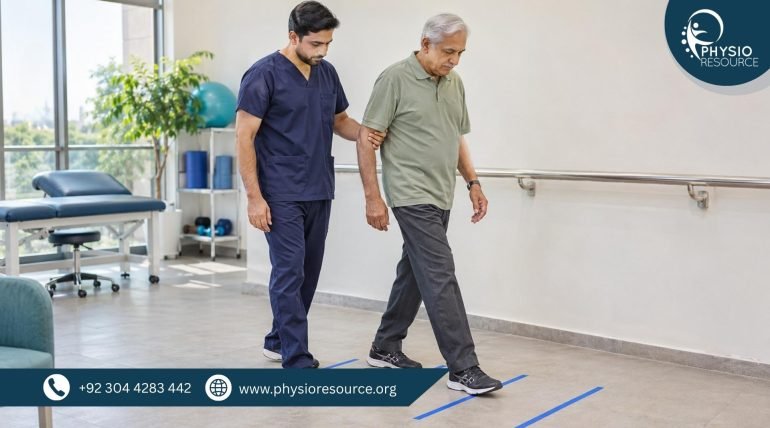
You want to take a step, but your feet simply will not move. You try again, lean forward, but remain stuck in the same position. If this sounds familiar, you may be experiencing freezing of gait, a common and frustrating movement problem in Parkinson’s disease.
For many people, it happens when starting to walk, turning around, passing through a doorway or walking in a crowded place. The good news is that Parkinson’s physiotherapy can teach practical strategies to make walking safer and help manage freezing episodes.
What Is Freezing of Gait in Parkinson’s Disease?
Freezing of gait (FOG) is a temporary episode in which a person feels unable to start or continue walking, even though they want to move.
It may look like:
- Your feet suddenly feel stuck to the floor.
- You take very small, shuffling steps.
- Your feet move rapidly but you make little forward progress.
- You freeze when turning or approaching a doorway.
- You feel unsteady and worry about falling.
These episodes can last a few seconds or longer. They may become more frequent as Parkinson’s disease progresses, although everyone’s experience is different.
You may also like: Why Do My Legs Feel Heavy While Walking? All you Need to Know
Why Does Freezing Happen?
Parkinson’s affects the brain systems responsible for controlling movement. Walking normally happens automatically, but Parkinson’s can make starting, stopping and changing direction more difficult.
Freezing may be triggered by:
- Starting to walk after sitting.
- Turning in a small space.
- Walking through narrow doorways.
- Dividing attention between walking and talking.
- Stress, anxiety or feeling rushed.
- Changes in medication response.
If freezing becomes more frequent, discuss it with your neurologist. Medication timing and response may need review. Never change Parkinson’s medication without medical advice.
How Can Physiotherapy Help With Freezing of Gait?
Physiotherapy for Parkinson’s disease focuses on improving walking, balance, movement control and everyday independence. A trained physiotherapist can identify situations that trigger freezing and develop strategies around the patient’s individual needs.
Treatment may include:
1. Visual and auditory cueing
A line on the floor, rhythmic counting or a steady sound can provide an external signal to help initiate a step.
2. Gait training
Practising step length, heel contact, walking rhythm and controlled turns can help improve walking technique.
3. Balance and strength exercises
Targeted exercises can improve postural control, leg strength and confidence during daily activities.
4. Turning and movement strategies
Patients can learn to avoid rushing or pivoting suddenly and practise controlled, step-by-step turns.
5. Functional walking practice
Training can include situations that commonly trigger freezing, such as doorways, narrow spaces and changing direction.
The aim is not to cure Parkinson’s disease. It is to help the person move more safely and manage difficult walking situations. Research supports several physiotherapy approaches, although the effect on freezing itself varies between individuals.
What Should You Do When Your Feet Freeze?
If you experience a freezing episode:
- Stop pushing yourself forward.
- Take a moment to regain your balance.
- Shift your weight gently from one foot to the other.
- Try stepping over an imaginary line or using a simple counting rhythm.
- Restart with a deliberate, controlled step.
Practise these techniques with professional guidance, especially if you have a history of falls. Keep walking areas clear and use prescribed walking aids correctly.
Looking for Parkinson’s Physiotherapy in Lahore?
Finding the right neurological physiotherapy in Lahore can make an important difference to how a person manages everyday movement difficulties.
At Physio Resource, Gulberg III, Lahore, patients and families can enquire about physiotherapy and rehabilitation services. Whether you are searching for a physiotherapy clinic in Gulberg, DHA, Johar Town, Faisal Town, Walton or Lahore Cantt, contact the clinic to confirm relevant service availability and appointments.
If you are comparing the best physiotherapy clinics in Lahore or looking for a physiotherapist near you, focus on appropriate neurological assessment, individual treatment planning and safe rehabilitation.
Don’t let every step become a struggle. Contact Physio Resource to enquire about an assessment and the next step for Parkinson’s rehabilitation.
Contact us
Phone No: 0304-4283442
Physio Resource
Address: 93-A1, Gurumangat Road, Gullberg, III Lahore
Frequently Asked Questions
1. Can physiotherapy stop freezing of gait in Parkinson’s disease?
Physiotherapy can teach strategies to manage freezing and improve walking safety. It cannot guarantee that freezing episodes will disappear.
2. Which exercises help with freezing of gait?
Depending on the person’s ability, treatment may include gait practice, cue-based stepping, balance exercises, strength training and controlled turning.
3. Why do Parkinson’s patients freeze when turning?
Turning requires several coordinated movements. Parkinson’s can make these movements slower and more difficult to organise, triggering a freezing episode.
4. Can walking cues really help Parkinson’s patients?
Visual, auditory and attentional cues can help some people restart movement or improve walking. The most useful cue depends on the individual.
5. When should someone with Parkinson’s see a physiotherapist?
When walking becomes difficult, freezing episodes increase, balance worsens or falls occur, ask the treating doctor about a neurological physiotherapy assessment.
About the Author
Dr. Ahmed Bilal — Physio Resource
Dr. Ahmed Bilal is the named author of this educational article for Physio Resource. The article provides general health information and does not replace an individual clinical assessment.

