

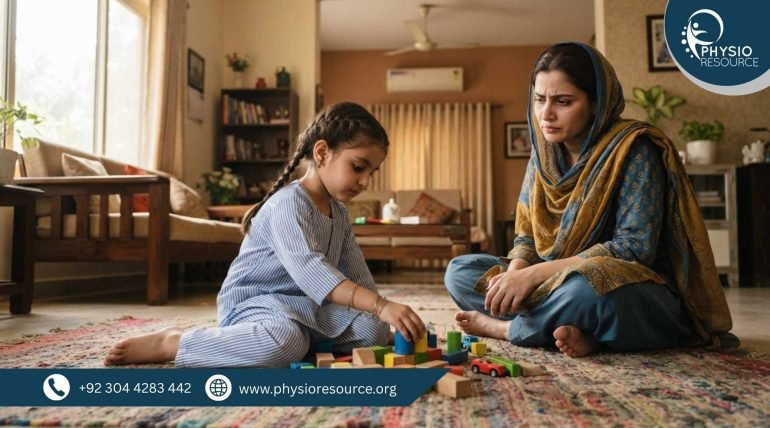
Yes—but only if your child sits in the W-position most of the time. Occasional W-sitting is common in young children, but frequent or prolonged W-sitting may affect posture, balance, muscle development, and coordination. At Physio Resource, home to some of the Best Child Specialists in Lahore, Best Pediatric Physiotherapists in Lahore, and the Best Physiotherapists in Lahore, we regularly assess children with movement and posture concerns. Whether you need an experienced Best Female Physiotherapist or expert pediatric rehabilitation in Gulberg, Lahore, early assessment can prevent long-term problems. This article is medically reviewed by Dr. Ahmed Bilal, an experienced rehabilitation expert dedicated to evidence-based pediatric care.
What Is W-Sitting?
W-sitting is a sitting position where a child sits on the floor with their knees bent, feet behind them, and legs forming the shape of the letter “W.”
Many toddlers naturally choose this position because it gives them a wide base of support, making it easier to play without losing balance. While sitting this way occasionally isn’t harmful, using it as the primary sitting position may indicate underlying muscle weakness, low muscle tone, joint hypermobility, or poor core stability.
You may also like: Why Is My Baby’s Head Tilted to One Side?
Why Do Some Children Prefer W-Sitting?
Children often choose W-sitting because it requires less effort from their core muscles. Instead of using their abdominal and back muscles to stay upright, the position provides extra stability.
Your child may prefer W-sitting if they have:
- Weak core muscles
- Poor balance
- Low muscle tone
- Increased flexibility (hypermobility)
- Delayed motor development
Rather than being the problem itself, W-sitting is often a sign that your child’s muscles need proper assessment.
Can W-Sitting Cause Problems?
If W-sitting becomes a daily habit, it may contribute to:
- Poor posture
- Reduced trunk strength
- Delayed balance and coordination
- Limited trunk rotation
- Difficulty crossing the body’s midline
- Abnormal walking or running patterns
- Increased stress on hips, knees, and ankles
These challenges can affect a child’s physical development if left unaddressed.
When Should Parents Seek Help?
You should consider an assessment if your child:
- Almost always sits in the W-position.
- Finds it difficult to sit cross-legged.
- Falls more than other children.
- Shows delayed motor milestones.
- Complains of leg pain or fatigue.
- Has noticeable balance or coordination difficulties.
Early intervention is always easier than correcting long-standing movement patterns.
How Can Pediatric Physiotherapy Help?
At Physio Resource, our pediatric physiotherapists perform a detailed assessment to identify the real reason behind your child’s W-sitting habit.
Treatment may include:
- Core strengthening exercises
- Balance and coordination training
- Postural correction
- Play-based movement therapy
- Stretching and strengthening programs
- Parent education with practical home activities
Every treatment plan is personalized according to your child’s age, development, and specific needs.
Give Your Child the Best Start
Not every child who W-sits has a serious problem—but every child who consistently W-sits deserves a professional assessment. Early physiotherapy can improve posture, movement, confidence, and overall physical development.
If you’re concerned about your child’s sitting posture, don’t wait for the problem to become permanent. Book a pediatric physiotherapy assessment at Physio Resource in Gulberg, Lahore, and let our experienced team help your child move, play, and grow with confidence.
Schedule an Appointment
Physio Resource
Phone No: 0304-4283442
Address: 93-A1, Gurumangat Road, Gullberg, III Lahore
Frequently Asked Questions (FAQs)
Is W-sitting normal for toddlers?
Yes, occasional W-sitting is common. However, if it becomes your child’s preferred sitting position, it should be assessed by a pediatric physiotherapist.
Does W-sitting always need treatment?
No. Treatment is only needed if W-sitting is frequent or associated with muscle weakness, poor balance, delayed milestones, or posture problems.
How can I stop my child from W-sitting?
Gently encourage alternative positions like cross-legged (“criss-cross”), side sitting, or long sitting, and seek physiotherapy if the habit persists.
Can W-sitting affect my child’s walking?
Yes. Long-term W-sitting may contribute to poor posture, reduced core strength, and altered movement patterns that can influence walking and running.
Where can I find the best pediatric physiotherapist in Lahore for W-sitting assessment?
Physio Resource in Gulberg, Lahore provides evidence-based pediatric physiotherapy, with assessments and treatment supervised by experienced clinicians, including Dr. Ahmed Bilal.

