

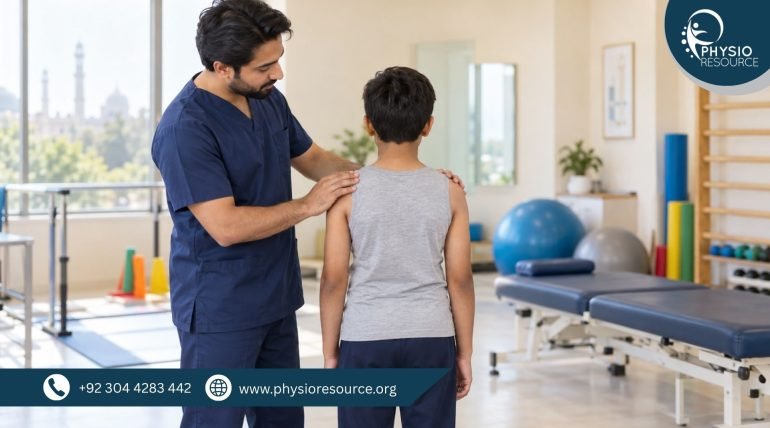
Have you noticed that one of your child’s shoulders sits higher than the other? Does their back look uneven, or does one shoulder blade appear more prominent? These changes may be related to posture, but they can also be signs of scoliosis in children.
At Physio Resource in Gulberg, Lahore, we encourage parents to seek an appropriate assessment when they notice persistent changes in their child’s posture. Early evaluation helps identify the cause and determine the next steps.
5 Signs Your Child May Need a Scoliosis Assessment
Check your child’s posture for these possible warning signs:
- Uneven shoulders: One shoulder consistently appears higher than the other.
- Prominent shoulder blade: One shoulder blade sticks out more noticeably.
- Uneven hips: One hip appears higher, or the waist looks different on each side.
- Leaning to one side: Your child’s body appears tilted when standing naturally.
- Uneven rib cage: One side of the back looks higher when your child bends forward.
These signs do not automatically mean your child has scoliosis. However, if you notice one or more of them, arrange a professional assessment rather than relying on photographs or home posture checks alone.
What Is Scoliosis, and Why Does Early Assessment Matter?
Scoliosis is a condition involving a sideways curve of the spine, often accompanied by rotation of the vertebrae. It can develop gradually, particularly during periods of rapid growth.
Many children with scoliosis do not experience pain, so visible postural changes may be the first sign a parent notices. A medical professional can assess spinal alignment, review your child’s medical history and determine whether imaging, such as an X-ray, is needed.
Remember: an uneven shoulder does not confirm scoliosis, and a physiotherapy assessment alone cannot always establish the diagnosis.
You may also like: Frozen Shoulder Treatment in Lahore – Call Now
When Should You Book a Pediatric Physiotherapy Assessment?
Consider booking an assessment if your child’s shoulders remain uneven, their posture appears increasingly asymmetrical, or you notice changes in their back, waist or hips.
At Physio Resource, a physiotherapy assessment can help evaluate posture, movement, muscle function and any associated discomfort. If scoliosis is suspected, your child may need assessment by a qualified medical doctor, such as a pediatrician or orthopedic specialist.
Seek prompt medical advice if the asymmetry develops suddenly, progresses quickly, or is accompanied by significant pain, weakness, numbness or difficulty walking.
Can Physiotherapy Help Children With Scoliosis?
Depending on the diagnosis and severity of the spinal curve, treatment may involve monitoring, scoliosis-specific exercises, bracing or other specialist-directed care.
Physiotherapy may form part of an individualised management plan. The appropriate
approach depends on your child’s age, growth stage, spinal curve and medical assessment.
General posture exercises alone should not be presented as a cure for scoliosis.
If you are searching for the best pediatric physiotherapist in Lahore or the best physiotherapist in Lahore, look for appropriate qualifications, experience in children’s rehabilitation and a clear, evidence-informed approach. Parents seeking a female
physiotherapist can also ask about the clinic’s available practitioners.
Book a Scoliosis-Related Assessment in Gulberg, Lahore
Noticed uneven shoulders or changes in your child’s posture? Do not panic, but do not ignore persistent changes either. Getting the right assessment can help you understand what is happening and which next steps are appropriate.
Contact Physio Resource to discuss your child’s assessment needs.
Contact us
Physio Resource
Phone No: 0304-4283442
Address: 93-A1, Gurumangat Road, Gullberg, III Lahore
Frequently Asked Questions (FAQs)
1. Does one shoulder being higher than the other mean my child has scoliosis?
Not necessarily. Uneven shoulders can have several causes, but persistent asymmetry may be a sign of scoliosis and should be assessed professionally.
2. At what age can children develop scoliosis?
Scoliosis can develop at different ages. Adolescent idiopathic scoliosis commonly appears around the growth-spurt years, particularly between ages 10 and 18.
3. Can scoliosis occur without back pain?
Yes. Many children with scoliosis have no pain, which is why visible changes in shoulder height, hips or spinal alignment should not be ignored.
4. Can physiotherapy correct scoliosis in children?
Physiotherapy may help manage scoliosis through appropriate, individualised exercises and movement guidance. Results depend on the child’s condition, and physiotherapy should complement medical assessment when indicated.
5. Where can I book a scoliosis-related assessment in Lahore?
You can contact Physio Resource in Gulberg III, Lahore, at +92 304 4283442 to discuss your child’s symptoms and available assessment options.
Author: Dr. Ahmad Bilal, Consultant Physiotherapist
Helping parents make informed decisions about their children’s posture, movement and physical health.

